

This post may contain affiliate links. If you buy through them, I may earn a small commission at no extra cost to you.
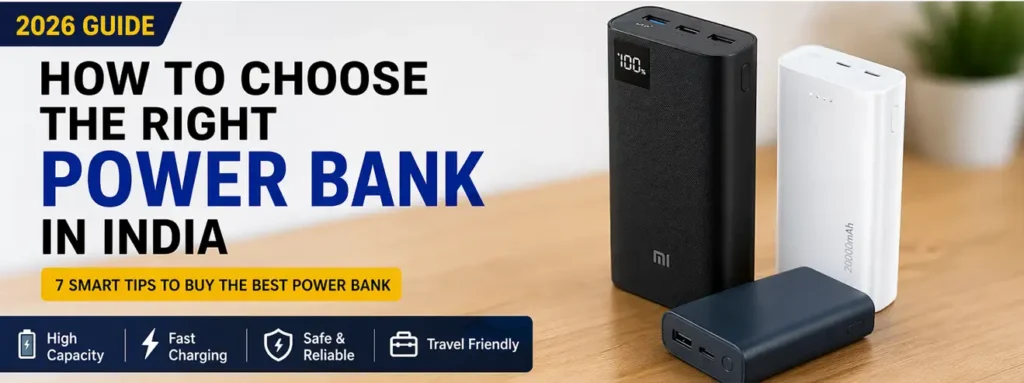
Choosing the right power bank in India depends on your phone, daily usage, charging speed requirements, and how much backup you need. With so many models available, choosing only by the mAh number can lead to the wrong purchase.
For most daily users, a 10,000mAh power bank is easier to carry, while a 20,000mAh model provides substantially more backup for travel and heavy use. But capacity alone shouldn’t determine your choice. USB-C support, charging protocols, output power, input speed, safety features, and compatibility with your devices also matter.
In this guide, you’ll learn how to choose the right power bank based on capacity, charging speed, ports, safety features, size, input charging speed and warranty—not just marketing claims.
How to Choose the Right Power Bank in India – Key Factors
1. Capacity (mAh): Choose Based on Your Usage
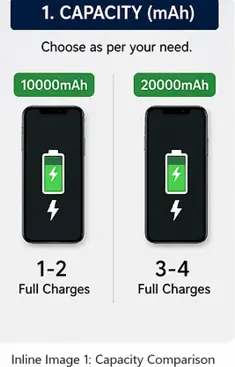
Capacity is one of the first things to consider when deciding how to choose the right power bank. A 10,000mAh model is generally easier to carry and is suitable for everyday smartphone backup, while a 20,000mAh model provides more capacity for travel and heavier use.
However, don’t assume that a 20,000mAh power bank will always provide exactly twice as many phone charges as a 10,000mAh model. Actual usable energy is affected by conversion losses, the phone’s battery capacity and charging efficiency.
Choose based on your actual usage rather than simply buying the highest-capacity model.
👉 Choose based on daily usage, not the biggest number. You can read our post, Fast Charging vs Normal Charging Explained.
2. Fast Charging Support
When learning how to choose the right power bank, check the maximum charging speed supported by your phone first. A power bank with a higher wattage rating does not automatically charge every phone at that speed.
Look for compatibility with charging standards such as USB Power Delivery (USB PD) or Qualcomm Quick Charge, depending on what your phone supports.
Also check the power bank’s actual output specification rather than choosing only by the largest wattage number printed on the box.
3. Check the Port Types
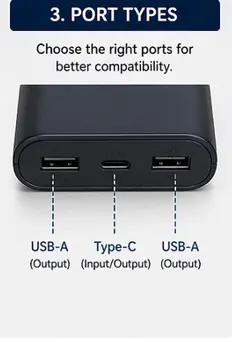
USB-C does not automatically mean fast charging. USB-C is a connector type, while charging speed depends on the power output and supported charging protocols.
When deciding how to choose the right power bank, check whether it has USB-C input, USB-C output or both, depending on your devices.
Multiple outputs can also be useful if you regularly need to charge two devices, but check how the available power is shared when multiple devices are connected.
Tip: Prefer USB-C when it matches your devices and charging requirements, but always check the actual wattage and supported charging standards.
4. Safety Features Are Important
A power bank contains a rechargeable lithium battery, so safety features should be an important part of your decision. Look for products that specify protections such as:
- Overcharge protection
- Overcurrent protection
- Short-circuit protection
- Over-temperature protection
- Over-voltage protection
Also check the manufacturer’s warranty and buy from a reputable seller. Don’t choose an unknown model simply because it offers unusually high capacity at a very low price.tion are also useful signs when comparing products. Avoid choosing an unknown model simply because it offers a very high capacity or unusually low price.
👉 Cheap power banks can damage your phone. 👉 Lithium-ion battery safety guidelines
5. Size & Weight
- Slim → easy to carry
- Heavy → more backup
👉 Balance both
6. Input Charging Speed
This is ignored by most people.
👉 Fast input = the power bank charges faster
7. Brand & Warranty
Choose trusted brands like:
- Mi
- Ambrane
- Redmi
👉 Always check the warranty.
Power Bank Buying Guide at a Glance
| Your Priority | What to Choose | Why |
|---|---|---|
| Light daily backup | 10,000mAh | Easier to carry |
| Frequent travel | 20,000mAh | More backup |
| Fast charging | Compatible fast-charging standard + suitable output | Better device compatibility |
| Multiple devices | Multiple outputs | More flexible charging |
| Frequent power-bank use | Faster input charging | Reduces recharge waiting time |
| Maximum portability | Slim 10,000mAh model | Lower bulk and weight |
Comparison Table (Quick Decision)
| Feature | 10000mAh Power Bank | 20000mAh Power Bank |
|---|---|---|
| Capacity | Medium | High |
| Charging Cycles | 1–2 | 3–4 |
| Weight | Light | Heavy |
| Best For | Daily use | Travel |
| Charging Time | Faster | Slower |
Final Checklist
Before buying, ask:
- Do I need 10k or 20k mAh?
- Does it support fast charging?
- Does it have Type-C?
- Is the brand reliable?
👉 Also read: Mistakes to Avoid While Buying Power Banks.
Ready to Compare Actual Power Banks?
Once you’ve decided what capacity and charging features you need, the next step is comparing actual models. We have separate guides for different budgets and use cases:
Looking for a budget-friendly power bank?
Compare our Best Power Banks Under ₹1,500 guide to see suitable options for everyday use.
Need more backup for travel or heavy use?
See our Best 20,000mAh Power Banks Under ₹2,000 guide for larger-capacity options.
Prices and availability can change, so always check the current product listing before buying.
Which Power Bank Should You Choose?
For everyday use: Choose a 10,000mAh model if you want something easier to carry and mainly need smartphone backup during the day.
For travel: A 20,000mAh model is more suitable when you need longer backup between charging opportunities.
For fast charging: Match the power bank’s supported charging standard and output with your phone.
For multiple devices: Look for multiple outputs and check how the available power is distributed when more than one device is connected.
For frequent use: Consider both the power bank’s output speed and how quickly the power bank itself can be recharged.
Ready to Compare Power Banks?
If you’ve decided what type of power bank you need, you can now compare actual models from our buying guides:
For budget-friendly options: See our Best Power Banks Under ₹1,500 guide.
For longer backup: See our Best 20,000mAh Power Banks Under ₹2,000 guide.
These guides compare specific models so you can check their features and current availability before buying.
Final Verdict
Knowing how to choose the right power bank is more important than simply choosing the model with the highest mAh rating.
Start with your daily usage and decide whether portability or longer backup is more important. Then check charging speed, supported charging standards, ports, safety features, size, weight and warranty.
A 10,000mAh model is a practical choice for many everyday users, while a 20,000mAh model makes more sense when you need extended backup for travel or heavier use.
Finally, compare the actual specifications of the models you’re considering rather than relying only on capacity or wattage claims.
FAQs
Q1. How do I choose the right power bank for daily use?
For everyday smartphone backup, a 10,000mAh power bank is often a practical starting point because it provides useful backup without the bulk of a larger-capacity model. Also check charging speed, USB-C support, and compatibility with your phone.
Q2. Is a 20,000mAh power bank better than a 10,000mAh model?
Not necessarily. A 20,000mAh model provides more capacity but is generally larger and heavier. Choose it when longer backup is more important than portability.
Q3. Does higher wattage mean faster charging?
Not automatically. The phone, power bank, cable and supported charging protocol all affect charging speed. Check whether the power bank supports the charging standard and output required by your phone.
Q4. Is USB-C better than USB-A on a power bank?
USB-C is generally more convenient for modern devices, but USB-C alone does not guarantee fast charging. Check the port’s actual output and supported charging standards before buying.