

This post may contain affiliate links. If you buy through them, I may earn a small commission at no extra cost to you.

Mistakes to Avoid When Buying Power Banks can save you from choosing a power bank that is too weak, too bulky, poorly equipped, or unsuitable for your devices. Many buyers focus only on capacity or price and overlook charging speed, ports, safety features and overall build quality.
Before buying a power bank, it is worth checking how much capacity you actually need, what charging standards your phone supports, which ports you require and whether the product comes from a reliable manufacturer. In this guide, we cover the most common mistakes to avoid when buying power banks and what to check instead.
The goal isn’t to find the power bank with the biggest number on the box. It’s to find one that actually matches your phone, usage and travel needs.
7 Buying Mistakes to Avoid When Buying Power Banks
1. Choosing Capacity Without Considering Your Usage
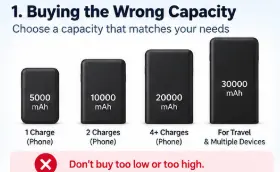
A larger capacity isn’t automatically better. A 20,000mAh power bank can provide more reserve capacity than a 10,000mAh model, but it will generally take up more space and add more weight to your bag.
A 10,000mAh power bank is often a practical choice for everyday smartphone backup, while a 20,000mAh model makes more sense for longer trips or heavier use.
Choose capacity according to how often you need backup and how much weight you’re comfortable carrying.
If you’re exploring more gadgets, check our guide on the best budget gadgets under ₹1000 in India.
2. Assuming Higher Wattage Always Means Faster Charging
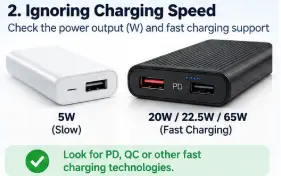
A power bank advertised with 22.5W, 33W or another high output does not automatically charge every phone at that speed. The actual charging rate depends on the phone’s charging capability, the power bank’s output and supported charging protocols, and the cable being used.
Before buying, check the charging standard supported by your phone and make sure the power bank provides a suitable output.
Don’t choose a power bank solely because it has the highest wattage number.
3. Assuming USB-C Automatically Means Fast Charging
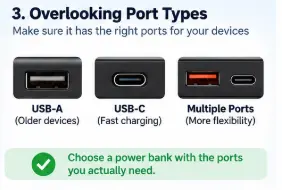
USB-C is a connector type, not a guarantee of fast charging. A USB-C port can support different power levels and charging standards.
When comparing power banks, check whether USB-C is used for input, output or both, and look at the actual wattage and supported charging protocols.
If your phone supports USB Power Delivery or another fast-charging technology, choosing a compatible power bank can help you take advantage of the charging capability your device supports.
4. Buying Only Because the Price Is Low
Price is important, but it shouldn’t be the only deciding factor. Some very low-cost power banks may provide limited information about their battery cells, protection features, actual output performance or warranty support.
Before buying, check the manufacturer’s specifications, warranty information, seller reputation and product feedback. A slightly higher purchase price can be worthwhile if the product provides clearer specifications and better support.
5. Ignoring Safety Features
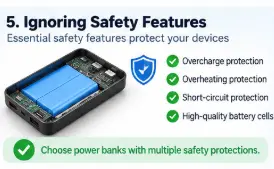
Safety should be one of the most important considerations when buying a power bank because it contains a rechargeable lithium battery. Look for products that clearly specify appropriate protection features.
Useful protection features can include:
- Overcharge protection
- Overcurrent protection
- Short-circuit protection
- Over-temperature protection
- Over-voltage protection
Also check the manufacturer’s warranty and avoid choosing an unknown product simply because it offers an unusually large capacity at a very low price.
Power-bank safety is important because lithium-ion batteries require appropriate protection against problems such as overcharging, overheating and short circuits. For additional information about lithium-ion battery safety, see UL Solutions’ lithium-ion battery safety information.
6. Ignoring Size and Weight
A power bank is useful only if you’re comfortable carrying it. A high-capacity model may provide more backup but can also be larger and heavier.
If you mainly need emergency backup during your commute or workday, a compact 10,000mAh model may be more convenient. If you’re travelling for longer periods without reliable access to a power socket, the additional capacity of a 20,000mAh model may justify the extra weight.
7. Forgetting About Warranty and Seller Information
Don’t overlook after-sales support when comparing power banks. Check the manufacturer’s warranty, seller information and return policy before buying.
Also look at recent customer feedback for recurring complaints about charging performance, physical damage, battery behaviour or reliability. Reviews should be treated as one source of information rather than the only basis for your decision.
If you want more options, explore the best mobile accessories for daily use.
Why Wattage Alone Isn’t Enough
Power bank wattage can be useful, but it should never be considered in isolation. A 33W power bank cannot force a phone to accept 33W if the phone supports a lower charging rate.
The phone, power bank, cable, and charging protocol all have to work together. That’s why checking compatibility is more useful than simply choosing the model with the largest wattage figure.
Think of wattage as one part of the charging equation—not the whole story.
Final Power Bank Buying Checklist
Before buying a power bank, check these points:
✔ Choose a capacity that matches your actual usage
✔ Check your phone’s supported charging speed
✔ Check the power bank’s output and charging protocols
✔ Confirm the USB-C/USB-A ports you actually need
✔ Check how power is shared when multiple devices are connected
✔ Look for clearly specified safety protections
✔ Consider size and weight
✔ Check manufacturer warranty and seller information
✔ Read recent customer feedback for recurring problems
✔ If buying for travel, check your airline’s current power-bank rules before flying
Ready to Compare Power Banks?
Avoiding these mistakes is only the first step. Once you know what capacity and charging features you need, the easiest way to make a buying decision is to compare actual power bank models.
For everyday and budget-friendly options, see our Best Power Banks Under ₹1,500 guide. We compare specific models so you can evaluate capacity, charging speed, ports, portability and overall value.
For longer backup, see our Best 20,000mAh Power Banks Under ₹2,000 guide. This is a better starting point if you travel frequently or need more reserve capacity.
Always check the current product specifications, price and availability before buying because Amazon listings and prices can change.
Which Power Bank Should You Choose?
Choose 10,000mAh if portability is important and you mainly need backup during the day.
Choose 20,000mAh if you travel frequently, use your phone heavily or need more backup between charging opportunities.
Choose a faster-charging model if your phone supports a compatible fast-charging standard and you regularly need quick top-ups.
Choose multiple outputs if you regularly charge more than one device, but check how the available power is distributed when several devices are connected.
Choose based on the complete specification, not simply the biggest capacity, highest wattage or lowest price.
Final Verdict
The biggest mistake when buying a power bank is choosing based on one specification alone. Capacity, charging speed, ports, safety features, size, weight, warranty and device compatibility all affect whether a power bank is actually suitable for you.
For many everyday users, 10,000mAh provides a useful balance between backup and portability. A 20,000mAh model is more suitable when longer backup is more important than carrying a lighter device.
Before buying, match the power bank’s charging capabilities with your phone and choose a product from a reputable manufacturer with clear specifications and warranty information.
If you already know the capacity you need, compare our recommended models in the relevant buying guide and check the current Amazon listing before making your final decision.