

This post may contain affiliate links. If you buy through them, I may earn a small commission at no extra cost to you.
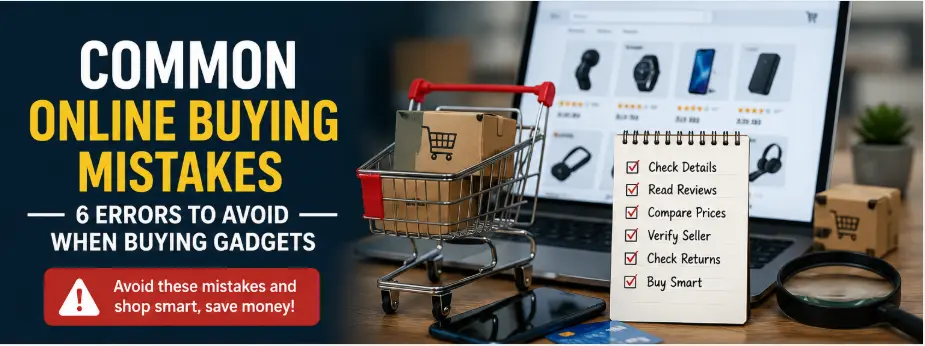
Common online buying mistakes can turn an otherwise good gadget purchase into an expensive disappointment. When shopping online, it is easy to focus on price, ratings, or discounts while overlooking compatibility, product specifications, warranty, and return conditions.
People often make mistakes when buying electronic gadgets online. Cheap electronics are popular because they help us save money. However, many buyers feel disappointed after purchasing budget gadgets that fail to function properly or meet their expectations. In most cases, the problem is not the product alone but the buying mistakes people make.
Understanding these common mistakes can help you avoid regret, make smarter decisions, and avoid buying cheap electronic products.
Common Online Buying Mistakes People Make When Buying Electronics
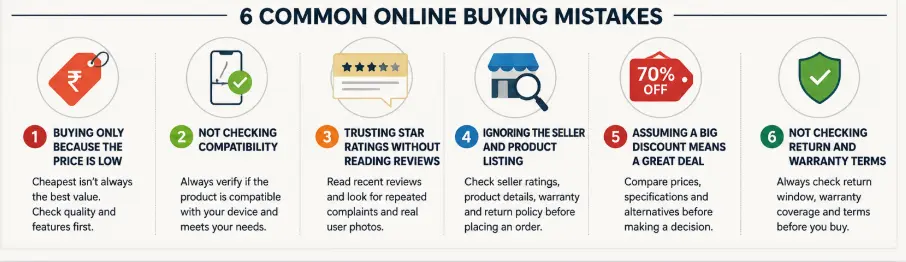
1. Buying Only Because the Price Is Low
A low price can be attractive, but it does not always mean you are getting good value. A very cheap gadget may use lower-quality materials, have limited features, poor durability, or weak after-sales support.
Before buying, compare the product’s specifications, build quality, warranty, and customer feedback with similar products. Sometimes spending a little more on a better-built product can save you from replacing it later.
The goal should not be to find the cheapest product, but to find a product that offers reasonable quality at a price that fits your needs.
Price should not be the only consideration. For more guidance, see our guide on how to choose long-lasting budget gadgets.
2. Not Checking Compatibility
One of the most common mistakes when buying electronics online is assuming that an accessory will work with your device simply because it looks compatible.
For example, a USB-C cable may fit a phone physically but may not support the charging speed or data-transfer capability you need. Similarly, a phone stand may not accommodate a large phone with its case attached.
Before ordering, check:
- Connector or port type
- Supported charging or data-transfer standards
- Device size and compatibility
- Required power rating
- Operating-system or device compatibility where applicable
- Whether the accessory works with your specific model
A few minutes spent checking compatibility can prevent an unnecessary return.
3. Trusting Star Ratings Without Reading Reviews
A high star rating can make a product look attractive, but the overall rating does not tell the complete story.
Before buying, read a selection of recent reviews rather than relying only on the average rating. Pay particular attention to repeated complaints about durability, charging performance, connectivity, comfort, overheating, or other problems relevant to the product.
It is also useful to look at 2-star, 3-star, and 4-star reviews. These reviews often provide more balanced information about both the strengths and weaknesses of a product.
Customer-uploaded photos can also help you understand what the product actually looks like compared with the listing images.
4. Ignoring the Seller and Product Listing
The product itself is not the only thing you should check when shopping online. The seller and the individual product listing also matter.
Before placing an order, verify the exact model, seller information, warranty details, and return conditions. Make sure the specifications shown in the listing match the product you intend to purchase.
This is particularly important when several versions of the same product are available. A listing may contain different capacities, colours, generations, or specifications, and selecting the wrong variant can result in receiving a product that does not meet your requirements.
5. Assuming a Big Discount Means a Great Deal
A large discount displayed on an online shopping site can create a sense of urgency, but the discount percentage alone does not tell you whether the product is actually good value.
Instead of focusing only on the original price and discount percentage, compare the current selling price with similar products and check what you are getting for the money.
Look at:
- Important specifications
- Build quality
- Warranty
- User feedback
- Features you actually need
- Prices of comparable products
A product advertised as 70% off can still be a poor purchase if a similarly priced alternative offers better quality or features.
Big discounts can be misleading. Some products show high original prices and heavy discounts to attract buyers, even though the actual value is much lower.
Instead of focusing on the discount percentage, compare features and overall value.
6. Not Checking Return and Warranty Terms
Return and warranty conditions are easy to overlook when you are focused on price and features, but they become important if the product develops a problem after purchase or when the product arrives damaged or stops working within a short time.
People often overlook return or replacement conditions when purchasing inexpensive electronics.
Before ordering an electronic product, check how long you have to return it, whether replacement is available, and what the manufacturer’s warranty covers.
Also check whether the warranty is provided by the manufacturer or seller and whether any conditions or exclusions apply.
For more expensive electronics, a clear warranty and reasonable return policy can be more valuable than saving a small amount on the initial purchase.
What to Check Before Clicking Buy
Rushed purchases often lead to dissatisfaction. Spending a few extra minutes reading product details and basic user feedback can save money and frustration.
Even budget electronics deserve thoughtful buying decisions.
- Is the product compatible with my device?
- Am I choosing it because of genuine value or simply because it is cheap?
- Have I read recent customer reviews?
- Have I checked the exact model and specifications?
- Have I checked the seller and return policy?
- Does the warranty provide reasonable protection?
- Have I compared it with at least one or two alternatives?
A quick check of these points can help you avoid many common online shopping mistakes and make a more informed buying decision.
Final thoughts
Buying cheap electronics does not mean buying carelessly. Avoiding these common online buying mistakes can help you make more informed gadget purchases and reduce the chances of buying something that does not meet your needs.
Smart buyers focus on value, not just price. With a little awareness, budget electronics can be both affordable and dependable.
FAQs
Q 1: What is the biggest mistake when buying cheap electronics?
Choosing a product only because it has the lowest price is one of the most common mistakes. Price should be considered alongside reliability, specifications, compatibility, and overall value.
Q 2: Why should I check compatibility before buying electronics?
Not every accessory works with every phone, laptop, or other device. Checking specifications such as connector type, power rating, and supported devices can help prevent compatibility problems, unnecessary returns, and poor performance.
Q 3: Should I check the return policy before buying cheap electronics?
Yes. Even inexpensive electronics can arrive damaged or stop working shortly after purchase. Checking the return window and replacement conditions before ordering can reduce the risk of being stuck with a faulty product.