

This post may contain affiliate links. If you buy through them, I may earn a small commission at no extra cost to you.
Fast Charging vs Normal Charging: Which Is Better for Your Phone?
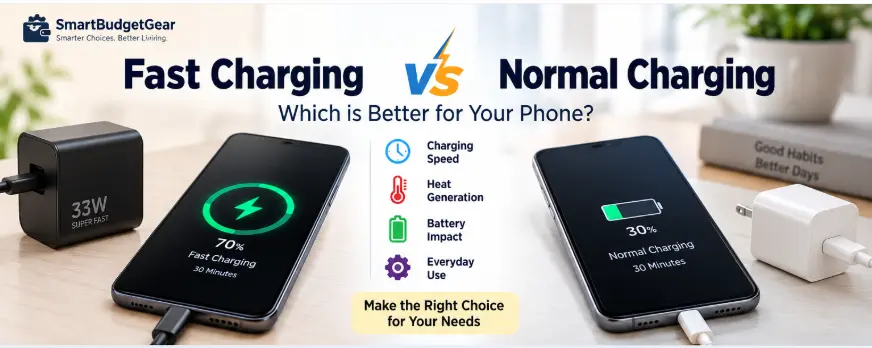
Fast charging vs normal charging is an important consideration for smartphone users who want a good balance between charging speed, convenience, and battery longevity. Fast charging can give you useful battery power in a short time, while lower-power charging can be more suitable when charging speed is not important.
Quick Answer: Fast charging is better when you need to recharge your phone quickly, while normal charging is useful when charging time is not important. Fast charging uses higher power and can generate more heat, but compatible smartphones and chargers are designed to regulate charging safely. For everyday use, the better choice depends on your phone, charger compatibility, and how quickly you need to recharge.
Fast charging does not automatically mean better battery health. Heat is an important factor in battery ageing, so using a compatible charger and avoiding excessive heat is more important than simply choosing the highest-wattage charger.
Let’s break it down in simple terms.
What is Normal Charging
Normal charging uses standard power output, typically 5W to 10W. It charges your phone slowly and steadily without generating much heat.
This type of charging has been used for years and is considered safe for long-term battery health.
What is Fast Charging
Fast charging uses higher power outputs like 18W, 33W, 65W, or even more to charge your phone quickly.
Modern smartphones support technologies like
- Qualcomm Quick Charge
- USB Power Delivery
These technologies adjust voltage and current to safely deliver faster charging speeds.
Fast Charging vs Normal Charging: Key Differences
Fast charging vs normal charging mainly differs in charging speed, power delivery, heat generation, and convenience. Fast charging is useful when you need to top up your battery quickly, while lower-power charging can be perfectly adequate when you have more time.
| Feature | Fast Charging | Normal / Lower-Power Charging |
|---|---|---|
| Charging speed | Faster | Slower |
| Power delivery | Higher power when supported | Lower power |
| Heat | Can generate more heat | Generally generates less heat |
| Convenience | Excellent for quick top-ups | Suitable when charging time is not important |
| Battery impact | Heat management matters | Generally involves lower charging heat |
| Best use | Quick top-ups, travel and daytime use | Longer charging periods |
Pros and Cons
Fast Charging
Pros:
- Saves time
- Ideal for busy users
- Great for emergencies
Cons:
- Generates heat
- Slight long-term battery wear
Normal Charging
Pros:
- Better battery longevity
- Less heat
- Stable charging
Cons:
- Slow
- Not practical for heavy users
Is Fast Charging Safe
Yes, fast charging is generally safe because modern smartphones include protection mechanisms like temperature control and voltage regulation.
However, prolonged exposure to excessive heat can slightly reduce battery lifespan.
Fast Charging vs Normal Charging – Which is Better?
There is no single winner between fast charging and normal charging. The better option depends on how you use your phone.
If you frequently need a quick battery top-up during the day, fast charging is more convenient. If your phone will be connected to a charger for several hours and speed is not important, lower-power charging may be perfectly adequate.
For battery longevity, the more important consideration is heat. Modern phones and chargers use charging controls to manage power, but excessive heat can contribute to battery ageing over time.
In other words, you don’t need to avoid fast charging completely. Use a compatible charger and cable, keep the phone reasonably cool while charging, and choose the charging speed that suits the situation.
To make the most of fast charging, you also need a compatible device. Here’s a complete guide on how to choose the right power bank for your needs.
Recommended Fast Chargers (Best Picks)
Mi 33W SonicCharge Fast Charger
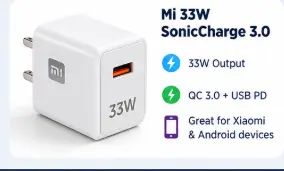
The Mi 33W SonicCharge Fast Charger is a suitable option for Xiaomi, Redmi, Poco and other compatible Android devices that can take advantage of higher charging power. The current article describes support for up to 33W charging, Qualcomm Quick Charge 3.0 and USB Power Delivery.
Its main advantage is charging speed, particularly for compatible devices. However, the actual charging speed depends on the smartphone’s supported charging standard and the charger-to-device combination.
Key Features
- Up to 33W charging
- Qualcomm Quick Charge 3.0 support
- USB Power Delivery support
- Type-C connectivity
- Safety protection features
- Compact design
Pros
- High 33W output
- Useful for compatible Xiaomi and Android phones
- Supports multiple charging standards
- Suitable for travel and everyday use
Cons
- A phone will not necessarily charge at 33W
- Actual speed depends on device compatibility
Best For
Xiaomi, Redmi, Poco, and compatible Android users who want faster charging.
SmartBudgetGear Assessment
4.5/5
A strong choice if your smartphone supports its charging standards. The main reason to choose it is the combination of higher output and broad compatibility rather than the 33W number alone.
boAt 18W QC 3.0 Fast Charger
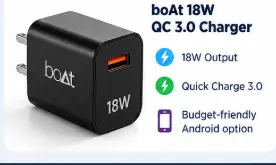
The boAt 18W QC 3.0 Fast Charger is a budget-oriented option for users who want faster charging without moving to a higher-power adapter. It supports Qualcomm Quick Charge 3.0 and includes safety features described on the current page.
Its 18W output is more modest than the Mi 33W charger, but it can still be a practical choice for compatible smartphones and everyday charging.
Key Features
- 18W fast charging
- Qualcomm Quick Charge 3.0
- Smart IC protection
- Compact design
- Suitable for compatible Android devices
Pros
- Affordable fast-charging option
- Compact and easy to carry
- Quick Charge 3.0 support
- Suitable for everyday use
Cons
- Lower output than 25W and 33W chargers
- Actual charging speed depends on device compatibility
Best For
Budget-conscious Android users who need a compact fast charger.
SmartBudgetGear Assessment
4.1/5
A sensible budget option if your phone supports Quick Charge 3.0. It is less suitable for users specifically looking for higher-power charging.
3. Samsung 25W Type-C Fast Charger
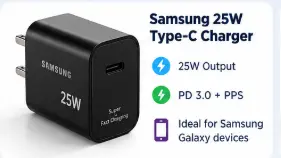
The Samsung 25W Type-C Fast Charger is designed for compatible Samsung Galaxy devices and supports USB Power Delivery with PPS. This makes it a particularly relevant option for Samsung users whose phones support Samsung Super Fast Charging.
Unlike simply choosing a charger with a higher wattage number, compatibility with the phone’s charging protocol is important. A 25W compatible charger can therefore be a better choice for a Samsung user than a higher-wattage charger that does not provide the required charging standard.
Key Features
- Up to 25W charging
- USB PD 3.0 with PPS
- Designed for compatible Samsung Galaxy devices
- USB-C connectivity
- Compact design
- Safety protection features
Pros
- Excellent match for compatible Samsung Galaxy phones
- PD/PPS support
- Compact and travel-friendly
- Reliable option for everyday charging
Cons
- 25W maximum output
- Best results depend on device and cable compatibility
Best For
Samsung Galaxy users who want compatible Super Fast Charging.
SmartBudgetGear Assessment
4.6/5
For compatible Samsung Galaxy users, this is the most straightforward choice of the three because the charging standard is closely matched to Samsung’s fast-charging ecosystem.
The current page’s product claims support 25W, PD 3.0, and PPS.
Comparison table (Mi vs Samsung vs boAt) fast charger
| Charger | Maximum Output | Charging Standard | Best For |
|---|---|---|---|
| Mi 33W SonicCharge | 33W | QC 3.0 + USB PD | Xiaomi/Android users |
| Samsung 25W Type-C | 25W | USB PD 3.0 + PPS | Compatible Samsung Galaxy phones |
| boAt 18W QC 3.0 | 18W | QC 3.0 | Budget Android users |
👉 “Check our guide on Best Budget Wireless Earbuds Under ₹1000 in India”
Final Verdict
Fast charging is the better choice when you need to recharge quickly, but the highest wattage is not automatically the best option. Your smartphone’s supported charging standard, the charger and the cable all need to work together.
For Xiaomi and compatible Android users: Mi 33W SonicCharge is the stronger high-output option.
For compatible Samsung Galaxy users: Samsung 25W Type-C is the best-matched choice.
For budget Android charging: boAt 18W QC 3.0 is the simpler affordable option.
If you regularly need quick battery top-ups, choose a compatible fast charger rather than buying a charger based only on its wattage rating.
FAQs
Q1. Is fast charging bad for battery health?
Fast charging itself is not necessarily bad for a smartphone battery. Modern phones use charging and temperature-management systems, but excessive heat can contribute to battery ageing. Using a compatible charger and keeping the phone reasonably cool is more important than avoiding fast charging altogether.
Q2. Is 33W charging faster than 25W charging?
Not necessarily. The phone determines how much power it can actually accept. A 33W charger will not make a phone charge at 33W if the phone supports a lower charging rate.
Q3. Does fast charging require a special cable?
It can. The charger, cable, and smartphone must support the required charging standard for the expected charging speed. A higher-wattage adapter alone does not guarantee faster charging.
Q4. Which is better for overnight charging?
If you have plenty of time, slower charging can be a practical choice because there is less need for high charging power. However, modern smartphones manage charging automatically, so using a compatible charger is more important than simply avoiding fast charging.